

Disney has released the latest of its Short Circuit Experimental Films, Reflect, which follows the story of a young ballet dancer struggling with self-image. Director Hillary Bradfield said in a pre-roll interview that it was inspired by her own experiences with body image and her body positivity journey.
This marks the first time a plus-sized female character has played the lead in a Disney animated film. The film starts with the dancer reluctantly walking over to a mirror to stand between several thinner dancers. As they work through ballet positions, the teacher instructs her to focus on “tight tummy, long neck”.

For the first time since 2016, Rihanna will release new solo music on Friday, October 28. The song, ‘Lift Me Up’ was made for the Black Panther sequel. According to the movie’s director, Ryan Coogler, the 34-year-old musician was motivated to work with the team out of respect for the late Chadwich Boseman.
“Honestly, I think it was Chad,” Coogler told the PA news agency on the red carpet at the Black Panther: Wakanda Forever premiere. “A lot of improbable things needed to happen for it to come through and Rihanna was very clear that she did that for him.”
Aemond Targaryen Failing to Control his Dragon is Actually Brilliant— and Thematically Coherent
October 26, 2022

*** Spoilers for the final episode of House of the Dragon ahead. Be warned. ***
The season finale of the first season of House of the Dragon confirmed that everyone better be ready for the bloody war that is coming for them next season. It also put a spin that I don’t think many people saw coming on one of the most famous events from the Dance of the Dragons, the inciting incident of it all— the death of Lucerys Velaryon and his dragon Arrax at the hand of Aemond Targaryen and his dragon Vhagar.
If there is a problem in society, you will most likely find Ruben Östlund in the panic room cackling at it. It’s a little futile to ask him about whether anything is off-limits, because you’re only asking for trouble. The two-time Palme D’Or winner (The Square in 2017, this year’s Triangle of Sadness) say that it isn’t, and proceed to educate you on capitalism, Marxism, #MeToo, hypocrisy and philanthropy. Which he did here, with a wicked smile and calm sense of control, when we spoke to him during a rare moment of quiet and serious conversation at this year’s BFI London Film Festival.
LWLies: Which language do you find it easiest to be funny in?
Ruben Östlund: I think it’s easier with Swedish, but my wife is German, and we speak English to each other. She was brought up in Australia, so I got some training in the English language to try to make her laugh. But then I also think the kind of situations that I’m dealing with in my films, very simple setups often, maybe I have to punch a little harder in English. The Square was a good trial for me. But the first scene in Triangle of Sadness when Carl [Harris Dickinson] and Yaya [Charlbi Dean] are arguing about the bill, it was easier for me to find the words exactly in Swedish.
I love that first sequence between Carl and Yaya, it’s excruciating. I’m interested to know what you think of the gender politics of the film industry, the way men and women speak about money when it comes to filmmaking in particular.
Since women are always paid less money than men, women become more like concerned about how they are paid when they get into the film industry. Many men going into the film industry don’t have any problem working for free for a couple of years, because they don’t have this on their shoulders that they are not treated equally.
I also think it’s a burden for women who can’t just go in like, ‘This is a fun group of people, I really want to spend time with them’ without thinking about not being treated equally. But then, of course, this is the beginning that I’m talking about. Because then when everybody started to get paid, then it’s a different issue, of course. I like to explore gender expectations and the way culture has trained us to behave, and how we’re dealing with it. #MeToo was a great movement, but you also could do #IGotBilled, and the men could tell the stories about when they were treated like a wallet. But when I bring it up, the men just say: “I can’t go there.”
Do you relate to that sentiment in any way? The sense of humour in your films is often risky – when is the point where you worry and have to pull back?
There are some jokes in this film that I didn’t go for. When you get older as a filmmaker and you’ve tried certain provocations, you realise that some areas bring about guilt by association. For example, I don’t think I’d redo [2011 feature] Play in the same way. It’s about five Black boys robbing three white boys and I was interested in looking at what we project on skin colour. It was inspired by real events, and these boys were playing into stereotypical ideas of Black men as dangerous, and it was taken straight out of popular culture, so I was questioning that representation when it came to the movie and the way it can reproduce a certain behaviour in reality. But if I don’t know how to motivate what I’ve done, I wouldn’t go into a provocation. But if I feel there’s a consensus thought on topics I don’t agree on, I’m willing to go into it.
For Triangle, I was interested in beauty as a currency. And it was written partly during the #MeToo movement, and I thought it was very interesting to have a man that has this currency in his sexuality and his beauty, and to see in which way he would use it if he ended up being dependent on a woman who had all the resources.
I want to talk about Harris Dickinson and his performance as Carl. He’s mentioned he doesn’t have much modelling experience, and you cast him opposite Charlbi Dean, who is incredible, and obviously has such extensive experience. How much does authenticity and that proximity to the real world matter to you?
It was good that Harris hadn’t done much modelling, because Charlbi was so comfortable in posing for the boyfriend of Instagram shots. I wanted Carl to start doubting his profession: “I don’t feel as beautiful as I did. I’m losing my currency and my looks.” But you could tell Charlbi had a huge amount of experience of being in front of a camera, and that made her a really skilful actor. She was not afraid of the camera at all – and it’s natural to be afraid of the camera, because it’s going to depict you exactly the way you are.
What did Charlbi teach you in terms of her experience?
I wanted Yaya to be more experienced when it comes to manoeuvring people who want to maybe have sex with her. So we talked a little bit about these things and I said, ‘Of course, you have to deal with thisa lot when you’re like travelling around, and meeting people in powerful positions.’ And she said, ‘I’m quite good at playing drunk, so I pretend to be drunk and that I have to go home.’
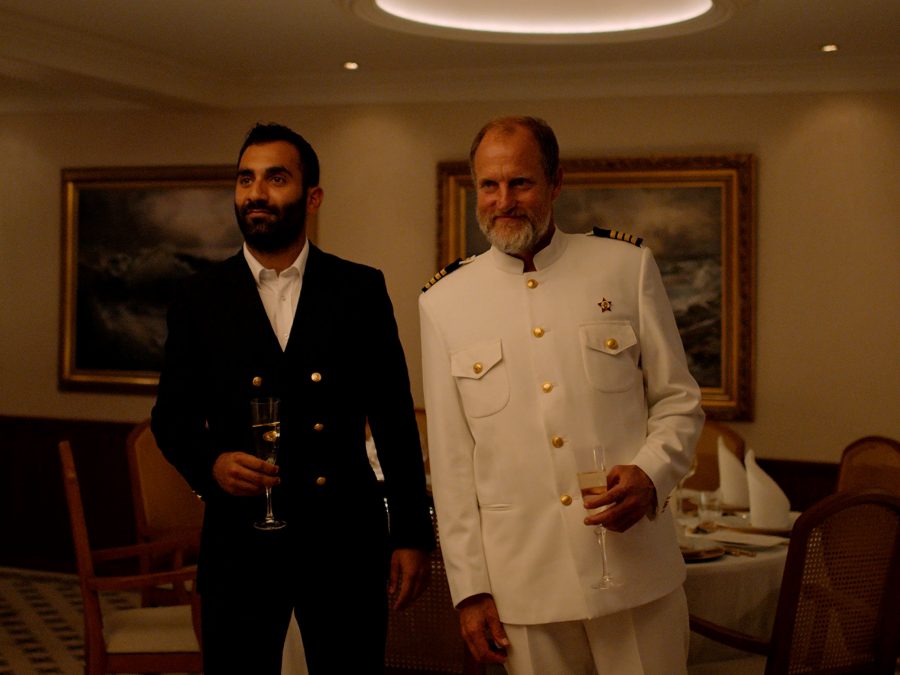
Much of Triangle Of Sadness, but one sequence in particular, demands an extremely visceral response from your audience. It’s something you’ve done often in your films, making people shriek and feel unwell. At this point in your career do you have a method to get these bodily reactions out of viewers?
I don’t know what it is, the characters are either peeing or shitting in all my movies, I don’t know why. I think there’s a reason why we react to vomiting. We are trained as animals to be afraid of it, because it can be a disease, an infection, bacteria, and we should avoid it.
I only knew that I wanted Woody Harrelson to play this Marxist captain that gets really drunk with the oligarch. They play with a microphone system, and they start reading all these political messengers to the vomiting passengers. I fell in love with that setup. I also knew that if I’m going to do vomiting, I don’t want to do it just a little bit, I wanted to push it further than what people expect me to do, and I want to the audience at a certain point to say, ‘Please save them, they’ve had enough.’ And then after that moment, I want to go even further.
It’s quite destabilising the way you combine that very physical, visceral, silly centrepiece with these political manifestos. How do you go about incorporating your politics into films that are being released into societies that just aren’t very left-wing?
I always want to ask people who watch my films: what is the political message? I’ve been completely uninterested in making it into like something that is supporting the left-wing socialist movement only. I think there’s a lot of great things with the market economy and great things with regulated capitalism.
When I was doing the film, I was almost wanting to go into the world we were dealing with in the 80s, when we had a Western perspective of the world and we had an Eastern perspective of the world. The Western perspective is delivering capitalistic ideas, and the Eastern is the socialist-communist ideas. So I thought it was almost like these two different ideologies have been bashing their head against each other. And I thought, haven’t we left that behind us? And now we can talk about how to really create a great, improved society.
So if you want to read something, where I agree on a lot of the thoughts on how we should build a better society, I will recommend a book called Utopia for Realists by Rutger Bregman. He is talking about basic income. I think that all of us agree on is that it’s not okay to exploit other people. And it’s not okay to pay them an unfair part of the profit. And if you look at Sweden during the 80s, social democracy actually managed to regulate capitalism in a quite good way, and we shared the responsibility of the society. But people have told me what’s going on in the UK now… I get sad when I hear that.
The political context in which Triangle Of Sadness premiered was somewhat contradictory, where everybody loved the film in Cannes, but I felt this tension between the audience laughing, thinking we’re so unlike these characters, while yacht parties are taking place right outside the screening room.
People working in the film industry and working with culture are often very interested in improving society. Even if you’re a billionaire. When you meet this billionaire, what do you want to tell them? Give away your money? Is that the solution? Do you believe in philanthropy? We have now a society where very rich people are motivating their position by also being great philanthropists.
Philanthropy is a way of maintaining power, it’s the luxury of being on top. So when we look at the audience in Cannes, there’s a word that I don’t like: “hypocrites”. It’s such an easy way of disqualifying people’s engagement in society. There are certain problems that can only be solved on society and a system level. We tend in our times to bring down these big topics and point fingers at the individual, saying, “Oh, so you’re flying, you should be ashamed.”
Come on, if we don’t share the responsibility for this, nothing will happen. It’s almost like consumer power, which is the most absurd thing that I’ve heard, because what is distributed to you is what you’re going to buy. But then you put the responsibility on the consumer and say, ‘Well, if there is a company that is not dealing with the environmental the crisis in a good way, you can buy another brand.’
I often think there’s the neoliberalist idea that we are free as individuals, and we can do whatever we want. But what Marx also invented was sociology, and it’s about human behaviour. And that comes from his specific context, and actually pointing fingers on the context and the situation that creates behaviour, rather than putting shame on the individual. And I think we lack that kind of view on the world and our actions today.
Of course, I want to confront myself, because I’m flying business class, I live in a five-star hotel when I’m travelling, and I have money in my bank account. But what should we do? Should we lay down and die?
The post Ruben Östlund: ‘I was interested in beauty as a currency’ appeared first on Little White Lies.
Look.
We’re Team Christine Brown all the way when it comes to her decision to leave Kody and restart her life in Utah.
That guy totally sucks and we’ve been so glad all these months to see how happy Christine has been in the wake of this move.
Great for her, you know?

Not as great?? In our opinion?
The way Christine continues to push a weight loss supplement that hasn’t been approved by the FDA and which produces questionable results.
As previously detailed, both Christine and Janelle Brown are paid spokeswomen for Plexus, a company that is “on the cutting edge of health science, with a range of products focused on every aspect of your health and happiness,” according to its official website.
“We help your body get rid of the bad stuff, pave the way to better digestive health, and feed your system to benefit the body and mind,” adds the organization.

It sounds a bit shady to us. It sounds like a pyramid scheme.
But Christine continues to push these products, most recently sharing a video on Instagram that includes the photographs featured above and below.
“My PINK DRINK called Slim Hunger Control has been a game changer in controlling my cravings, suppressing my appetite, and helping me balance my blood sugar so weight loss isn’t a struggle!” she wrote as a caption to this footage.
“Active & Metaburn also give me that boost of energy and burn that stubborn belly fat!”

Concluded the veteran Sister Wives star:
“I’m telling you, it’s that easy. And, the bonus… you don’t like it, you ship it back and get a FULL REFUND.
“Text me personally IM READY CHRISTINE to join me on this incredible journey to 928-769-8223. You can thank me later you can also message me at @the_secret_to_selfcare.”

Back in May, Meri Brown was forced to come out and issue a statement in the wake of major criticism aimed in her direction due to her involvement with LuLaRoe, a company that has also been labeled a pyramid scheme.
“Fun fact, a pyramid scheme is when you pay money and you don’t get anything in return,” Brown clapped back at critics at the time, adding:
“But with LuLaRoe you actually get something in return, and that’s called super cute clothes!”

As you can see, Meri has made no apologies for this side hustle. Heck, she’s proud of it.
Will Christine soon face the sort of backlash that has come Meri’s way?
Does she deserve to face this same sort of backlash?
Or are folks giving her a break because they simply like her more than Meri; because they are so very proud of her for standing up to Kody?

On Nov. 2, 2021, Christine took to Instagram to announce her separation from Kody.
“After more than 25 years together, Kody and I have grown apart and I have made the difficult decision to leave,” she wrote back then.
“We will continue to be a strong presence in each other’s lives as we parent our beautiful children and support our wonderful family.”
In response, Kody shared his own statement on social media, writing:
“Christine’s decision to leave comes with a great deal of sadness. We enjoyed many years together and I have a large amount of respect and admiration for her.
“Although we are moving forward on different paths, we will always remain committed parents.”
Christine Brown Flaunts New Figure, Pushes Shady Weight Loss Product on Fans was originally published on The Hollywood Gossip .
T years ago this Halloween, the BBC accidentally beamed a live seance into television sets across the UK, causing supernatural chaos in households up and down the country. At least, that’s what the folks behind Ghostwatch would have you believe. In reality, this now-cult slice of pre-internet telly was nothing more than an expertly-made Halloween drama that somehow spiralled wildly out of control, ultimately landing the Beeb with over 30,000 complaints.
Written by Stephen Volk and directed by Lesley Manning, this fictional drama was pre-filmed but aired as-live and followed a camera crew investigating a supposedly haunted London home. With roving reporters Sarah Greene and Craig Charles running around ‘live’ on the scene, we meet Pamela (Brid Brennan), a mum at her wit’s end after a poltergeist known as ‘Pipes’ (named after Pam’s explanation for the ghoul’s unexplainable noises) has been busy terrorizing her two young daughters. Meanwhile, TV icon Michael Parkinson was in the studio, playing himself and working with a parapsychologist (Gillian Bevan) to try and decipher fact from fiction. However it wasn’t long before things took a sinister turn, causing all hell to break loose – both on screen and off.
“I pitched the idea of a psychic investigator in cahoots with a film journalist,” explains Volk, revisiting Ghostwatch’s 1992 origins. “There was a show called World in Action, which was foot-in-the-door journalism where a reporter would ‘door-stop’ people and thrust a mic in their face. The idea was: what if that kind of reporter was investigating a haunted house? My original pitch was for a six-part drama series but we couldn’t do that, so I pitched it as a 90-minute one-off done as if it was going out live. Our pact with the devil was to try and pull that off.”
Enter Manning, the director with the mammoth task of athentically replicating the spontaneity of live TV: “My research was not in other dramas; it was all TV programmes and how they were presented,” she tells us. “Factual, light entertainment… we were absolutely looking in that area. The Blair Witch Project hadn’t happened yet. I remember watching Nightmare on Elm Street for its camera positions, what you tell and don’t tell the audience and when you reveal stuff. I didn’t have anything to go on.”
Without the benefit of music to add an eerie atmosphere, Manning enlisted the help of David Lean’s former Sound Designer, Winston Ryder, to amp up the frights. “It was exciting because he was from a different era,” recalls the director. “He’d get really excited about balloons being rubbed together to get cat noises or he’d play a cymbal backwards and say ‘I think this is really interesting for when you hear spooky feedback.’ He was really inventive.”
When it came to scares, Volk was keen to inject his own love of the genre: “I thought I had to layer on the tropes because if I made it too subtle, it’d look like nothing is happening, so I fed my knowledge of horror films in. The ghost ended up being a mixture of Norman Bates and Freddy Krueger, and the siege mentality is a little bit like The Birds or Night of the Living Dead but because it’s in such a different format, you don’t recognise those influences. It’s a straight-down-the-line ghost story, just told in a very different way.”

Speaking of spooks, Volk’s notorious ‘Pipes’ is hidden in various blink-and-you’ll-miss-it moments throughout Manning’s film, with eagle-eyed viewers taking great pleasure spotting him in the years since. “The important one for me is where you see him in the curtains and Parkinson says: “I don’t see anything, do you?’ That might have been the only one I put in the script but Lesley put more in. Nine or 10 have been spotted but I think she put more in than that. Some haven’t been spotted so far,” he reveals. “It’s become a game and part of the mythology, which I really love.”
Of course, some ideas proved too much: “I wanted to put in a very high-pitched sound that couldn’t be heard by humans and would drive pets mad. Dogs would start barking up and down the country and no one would know why. I actually think Lesley even looked into how to do that technically but they couldn’t, which is a bit scary,” chuckles Volk. “I also wanted a more out-there ending where Parkinson says ‘the ghost’s in the machine and coming to your home. Whatever you do, don’t switch off your TV.’ The idea was to leave it up in the air, like Pipes is coming to get you,” he smirks. “The producer said: ‘There’s no way we’re doing that.”
Despite these terrifying tricks staying on the cutting room floor, Ghostwatch was already notorious enough to spark outrage and engagement in equal measure. With a team of real parapsychologists manning phone lines that mirrored the fakes on screen, thousands of people called in with complaints and their own tales of ghostly encounters. “It went out at 9.25. Our Producer came to us at around 10.30 and said: ‘Oh my God, the phone lines have jammed. All across the country, people are wondering whether Sarah Greene’s okay,’” remembers Manning. “Many were reflecting on what they were seeing on TV – ‘something’s jumped off my table,’ that sort of thing – and the phone guys would tell them it’s fiction and try to calm them down. I was surprised everyone seemed to kick off on it.”
“I think people phoned in generally because they were either angry, scared or both,” reasons Volk. “I couldn’t quite believe it, to be honest. It seemed people, at least the people that phoned in, were taking it seriously.” For Manning, this tabloid reception was confusing: “We were trying to say something about the power of television and why you shouldn’t believe what you see and nobody got anywhere near that,” she suggests. “It was all: ‘Parkie’s broken faith with the nation,’ ‘obviously it’s real,’ ‘no, obviously it’s fake,’ ‘it’s obviously crap,’ ‘it’s obviously great’ – every single thing was thrown at us. It wasn’t all complaints but it was all very confused,” she adds. “In retrospect, I think the language I was so keen to use threw everybody.”
Blacklisted from the BBC, Ghostwatch has still never been repeated yet its impact on fans and pop-culture is undeniable. “People often say the same thing, which is it terrified them yet made them want to make horror films,” laughs Volk.
“Jed Shepherd who co-wrote Zoom horror Host interviewed me before he made the film and was very much influenced by Ghostwatch, and lots of others have said similar things. It’s nice to feel that people have taken inspiration from it to create something different so the genre revitalises itself.” Manning echoes the sentiment: “In the Q&As me and Steve do, lots of people say they watched it when they were 8, 9 or 10 – which I’m sure they shouldn’t have – and they say it opened doors to their careers and interest in horror,” she smiles. “I’m thrilled people are still talking about it.”
Ghostwatch is released for its 30th Anniversary on Blu-ray by 101 Films, 31st Oct 2022. The BFI Southbank presents an immersive screening of the film on Friday 28 October.
The post ‘Our pact with the devil was to try and pull it off’ Ghostwatch at 30 appeared first on Little White Lies.
